Field Automation
Execute critical field logic locally, with central governance
Run local acquisition, automation, alarms, historian and governed field commands with Scadify’s local-first industrial edge architecture.
Operational problem
Remote sites must continue acquiring, alarming and executing approved local logic through protocol diversity, brownfield equipment and intermittent central connectivity.
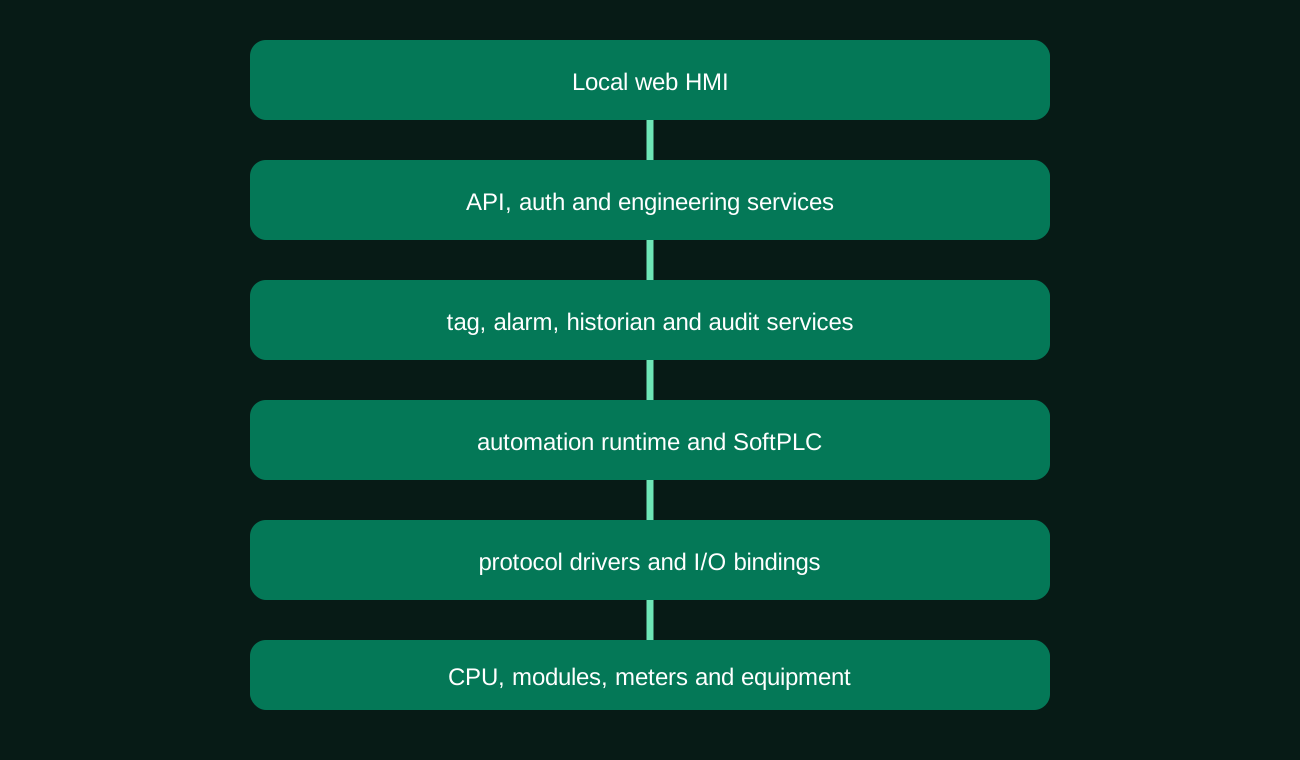
Scadify separates canonical tags, protocol drivers, local HMI, historian, alarms and automation runtime from physical hardware. EnergyPortal, enPowerManager and enCoreEnergy consume governed field evidence and provide higher-level context.
Core capabilities
Local-first runtime and cyclic execution
Configured according to the project’s data, control, approval and operating boundaries.
Canonical tags and I/O abstraction
Configured according to the project’s data, control, approval and operating boundaries.
SoftPLC-oriented governed automation
Configured according to the project’s data, control, approval and operating boundaries.
Local alarms, historian and HMI
Configured according to the project’s data, control, approval and operating boundaries.
Authenticated change, deployment history and rollback concepts
Configured according to the project’s data, control, approval and operating boundaries.
Products and delivery responsibilities
Assemble the operating stack around the action.
Operational workflow
From operational context to measured action.
- 01Bind signals to canonical tags
- 02Validate and deploy approved logic
- 03Run local acquisition and automation
- 04Record events, commands and health
- 05Synchronise central evidence when connected
Data sources and integrations
Connect the evidence that explains the decision.
- Meters, sensors, analyzers and actuators
- PLCs, RTUs, BMS and existing SCADA
- Modbus, MQTT and project-qualified telecontrol interfaces
- Local alarms, commands, deployments and audit logs
- Central configuration and operational policies
Governance and resilience
Scadify is intended for non-safety and project-qualified automation unless a separately validated safety architecture exists. Protocol maturity, hardware and certification status follow the release matrix.
Protocol roles, OEM compatibility, data retention, control limits and failure behaviour must be confirmed from the engineering-approved release and project documents.
Outcomes and KPI framework
Measure the operating result, not only the software activity.
Local-first operation and evidence
Use an agreed baseline, operational definition and evidence source before assigning a target.
Reusable device/tag model across field platforms
Use an agreed baseline, operational definition and evidence source before assigning a target.
Controlled protocol and command boundaries
Use an agreed baseline, operational definition and evidence source before assigning a target.
Staged integration and rollback visibility
Use an agreed baseline, operational definition and evidence source before assigning a target.
Solution architecture
Make responsibility visible from field to enterprise.
Scadify separates canonical tags, protocol drivers, local HMI, historian, alarms and automation runtime from physical hardware. EnergyPortal, enPowerManager and enCoreEnergy consume governed field evidence and provide higher-level context. The architecture separates observation, recommendation, human-approved action and local execution so that each team can see what it owns.
Engineering and implementation
Move from architecture to accepted operation.
Engineering scope can include I/O and protocol assessment, panel and network design, control logic, HMI, commissioning, migration, FAT/SAT, training and lifecycle support.
Publication boundary
Capabilities are described as supported or project-configured where appropriate. Customer identities, quantified results, certifications and regulatory acceptance are not inferred from the solution page.
Related solutions and products
Continue with the next operational question.
FAQ
Questions to resolve before implementation.
Is Scadify a PLC?
Scadify combines edge, local SCADA, historian and automation-runtime capabilities; its exact role depends on deployed hardware and configuration.
Can Scadify operate offline?
The architecture is local-first and intended to preserve essential functions subject to the released configuration and project qualification.
Can AI write directly to field equipment?
AI recommendations do not bypass permissions, interlocks or approved command paths; direct control requires an explicitly engineered mode.
Next step