Energy Storage

Coordinate storage safely within the wider power system.

Integrate BMS, PCS, meters and plant systems for BESS control, monitoring, dispatch, alarms, reporting and renewable or load coordination.

Discuss Your Project
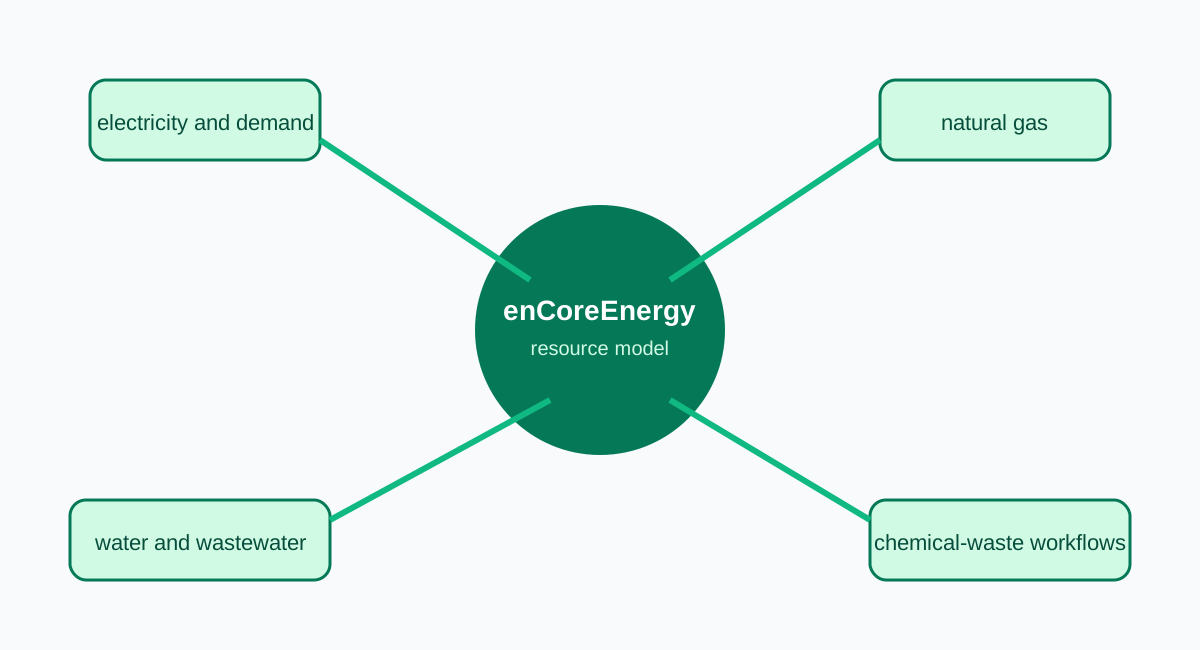
Energy storage architecture connecting BMS, PCS, PPC, meters and central operations
Conceptual architecture; final interfaces, controls and acceptance criteria are confirmed per project.

Who this is for

  • Storage owners and operators
  • Renewable and hybrid plant teams
  • BESS/EPC control engineers
  • Facility and demand-management teams

Typical assets and infrastructure

  • Battery management system
  • Power conversion system
  • Meters, protection and plant controllers
  • Renewable sources and facility loads

Operational problems

  • BMS, PCS, PPC and plant systems have different responsibilities.
  • State-of-charge limits and dispatch objectives must be visible before commands are issued.
  • Safety systems and operational control cannot be collapsed into one generic software claim.

Data sources

  • State of charge and capability limits
  • Charge/discharge status and alarms
  • Import/export, power and grid measurements
  • Dispatch schedule, tariffs and load context

Capabilities

A connected operating model for energy storage.

BMS and PCS integration boundaries

Configured around approved data, control, safety and responsibility boundaries.

State-of-charge and charge/discharge policies

Configured around approved data, control, safety and responsibility boundaries.

Renewable self-consumption and peak support

Configured around approved data, control, safety and responsibility boundaries.

Plant ramp and import/export coordination

Configured around approved data, control, safety and responsibility boundaries.

Alarms, reporting and local fallback where implemented

Configured around approved data, control, safety and responsibility boundaries.

Workflow

From field context to accountable action.

  1. 01Define BMS/PCS and plant responsibility
  2. 02Read state and capability limits
  3. 03Select approved dispatch objective
  4. 04Execute bounded command
  5. 05Record response, exception and evidence

Analytics and reporting

  • State, dispatch and energy history
  • Peak and tariff context
  • Renewable coordination and curtailment
  • Alarm and maintenance reporting

Engineering and resilience

Engineering can cover single-line and point-of-connection review, OEM/protocol assessment, control responsibility, network design, FAT/SAT, commissioning, grid tests, training and lifecycle support. Final supply and acceptance responsibilities are project-specific.

Security and operational continuity

Use segmented control networks, governed remote access, authenticated commands, least-privilege roles, local fallback, logging and project-specific backup/recovery. No automatic grid-code or security certification claim is made.

Publication-safe evidence

Evidence without exposing customer details.

Storage capabilities are presented as implemented or project-integrated only where documented; battery cells, fire suppression and complete safety engineering are not implied.

Related industries

Next step

Discuss the operating model your industry requires.

Discuss Your Project